What is Decision Fatigue? And Why Dinner Feels So Hard
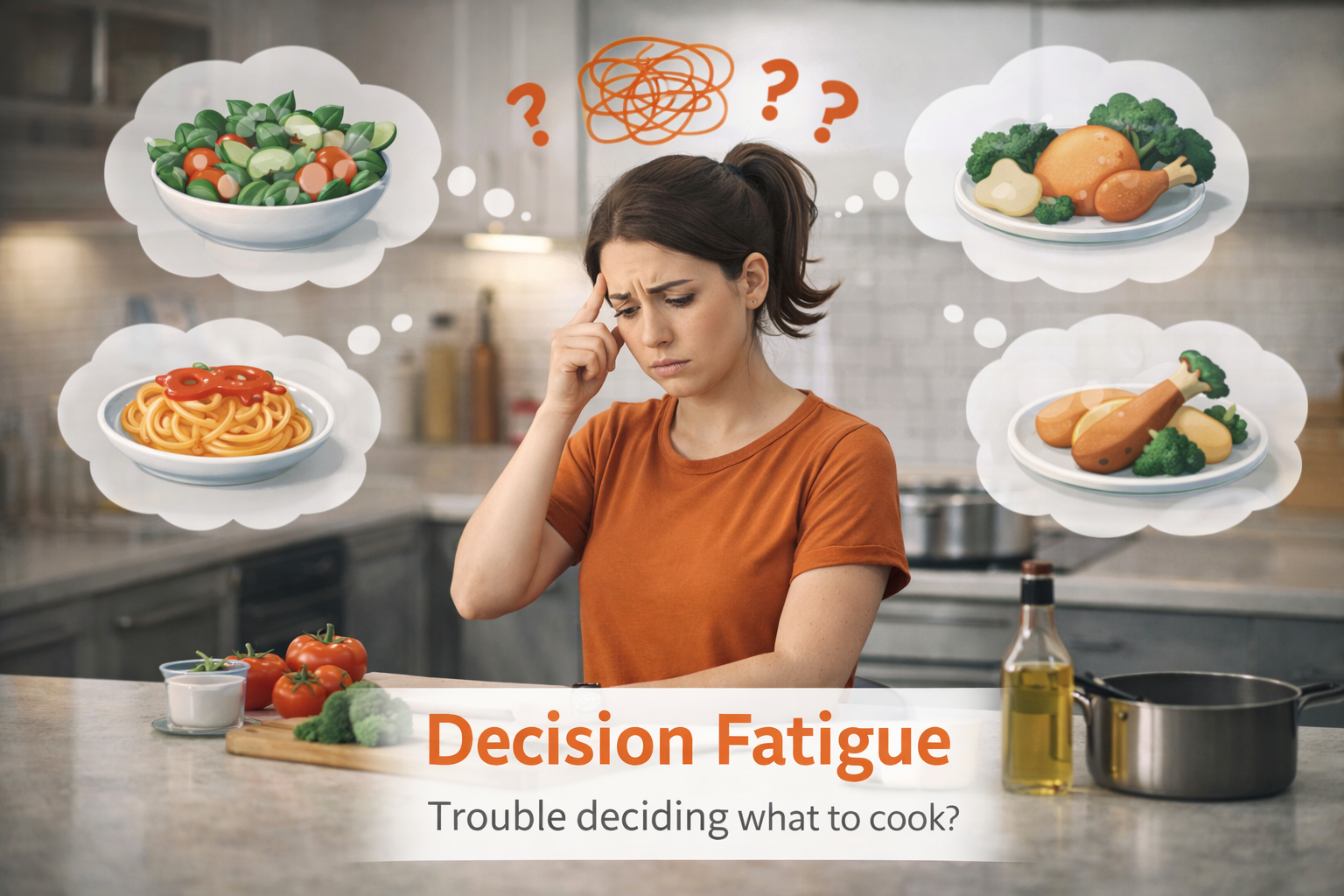
Decision fatigue is the mental exhaustion from making too many choices. Learn why deciding what to cook feels so hard — and what to do about it.
You've made thousands of decisions today. What to wear. What to say. What to prioritize at work. Which emails to answer first. Whether that meeting could have been an email.
By the time dinner rolls around, your brain has nothing left for one more choice. That's why "what's for dinner?" feels so impossibly hard at 6 PM — even though you have a stocked kitchen and a phone full of recipes.
This phenomenon has a name: decision fatigue.
What Decision Fatigue Actually Is
Decision fatigue is the deterioration of decision quality after making many decisions. It was popularized by social psychologist Roy Baumeister, who showed that making choices depletes the same mental resources you use for self-control and focus.
Key facts:
- The average adult makes about 35,000 decisions per day
- Decision quality declines as the number of decisions increases
- By evening, most people are operating at their lowest decision-making capacity
- Food decisions are especially vulnerable because they involve multiple sub-decisions (what to eat, what to buy, how to cook it, how long it takes)
Why Dinner Is Uniquely Hard
Dinner sits at the intersection of several decision-fatigue amplifiers:
- Time pressure: It needs to happen soon
- Resource constraints: You can only use what you have
- Preference juggling: Different people want different things
- Effort estimation: You need to assess how much energy cooking will take
- Nutritional considerations: There's guilt attached to "bad" choices
- The paradox of choice: Thousands of recipes make it harder, not easier
What Happens When You're Fatigued
When decision fatigue hits, you tend to:
- Default to the easiest option (takeout, cereal, skipping dinner)
- Delay the decision indefinitely (staring at the fridge for 20 minutes)
- Make impulsive choices (ordering expensive delivery you didn't budget for)
- Feel frustrated or overwhelmed by something that "shouldn't be hard"
None of these are failures. They're predictable consequences of a brain that's been working all day.
The Real Cost of Daily Dinner Decisions
Decision fatigue around dinner doesn't just affect one night. Over time it leads to:
- Spending more on takeout and delivery
- Eating less nutritiously
- Wasting food because you bought things without a plan
- Increasing stress in relationships ("What do YOU want for dinner?")
- A growing sense of dread around mealtimes
How to Fight Dinner Decision Fatigue
The most effective strategies involve reducing the number of decisions, not making better ones.
Reduce Your Options
Constrain yourself to 3–5 dinner options, not 30. Fewer choices = faster decisions.
Create Dinner Themes
Assign loose themes to nights of the week: Taco Tuesday, pasta night, soup day. This eliminates one entire layer of decision-making.
Prep Decisions, Not Meals
Instead of full meal prep, just decide in the morning what you'll cook tonight. A 30-second decision at 8 AM is easier than a 20-minute deliberation at 6 PM.
Outsource the Decision
This is the most effective strategy: let something else decide. This is exactly what Dishli.ai does — it removes the need to choose from infinite options by giving you a short, realistic list based on your actual constraints.
How Dishli.ai Eliminates Dinner Decision Fatigue
Dishli.ai was built specifically to solve this problem. Instead of giving you more recipes to browse, it asks you a few quick questions — what you have, how much time, how you're feeling — and then decides for you.
No browsing. No bookmarking. No decision paralysis. Just a short list of meals that actually work tonight.
It's the difference between "here are 10,000 recipes" and "here are 3 things you can make right now with what's in your kitchen." That's the power of fewer, better decisions.